
Home » Aquarium Setup » Best Low-Tech Plants for This Setup
Best Low-Tech Aquarium Plants for Beginners Without CO₂
Plant selection is one of the biggest factors that determines whether a beginner enjoys a planted aquarium or becomes frustrated by it.
A common mistake is choosing plants because they look attractive in photographs without first asking:
Does this plant suit my lighting, CO₂ level, aquarium size and maintenance ability?
For a low-tech nano aquarium, we prefer plants that can tolerate more moderate conditions and do not immediately outgrow the aquascape.
Our ₹4,999 setup therefore starts with Anubias and aquatic moss.
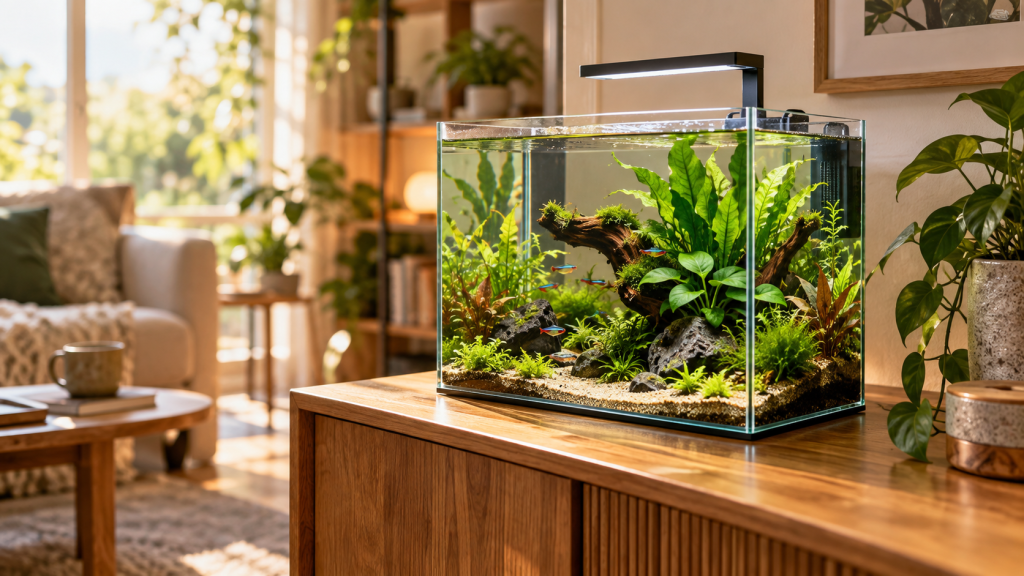
Why Anubias works so well
Anubias is one of the most widely recommended beginner freshwater aquarium plants.
It is relatively slow-growing, tolerates lower-light conditions and does not need to be rooted deeply into nutrient-rich substrate.
Aquarium Co-Op specifically recommends Anubias as an easy low-light plant and notes that it can be attached to rocks or driftwood.
The most important Anubias planting rule
Anubias grows from a thick horizontal structure called a rhizome.
The rhizome should not be completely buried in the substrate.
That is why Anubias works so beautifully attached around hardscape.
In our nature aquarium, the plant can be positioned around the rock formation, making the aquascape look established without requiring large amounts of planting soil.
Why moss is valuable in a nano aquascape
Moss performs a different visual job.
Where Anubias creates defined leaf shapes, moss creates texture.
It can make a piece of stone appear older, soften transitions and fill small areas where a conventional rooted plant would look disproportionate.
Java moss is particularly well known for being hardy and beginner-friendly, while aquascaping layouts also use Spiky, Christmas, Weeping and other mosses depending on the desired growth habit.
Does moss need CO₂?
Many aquarium mosses can grow without injected CO₂.
Growth may be slower than in a well-optimised CO₂ aquarium, but slow growth can actually be helpful in a small low-tech aquarium because constant trimming is not the goal.
What other plants can work in low-tech aquariums?
Once the customer understands the basic setup, there are other possibilities.
Cryptocoryne varieties, Java fern/Microsorum, Vallisneria, some Bucephalandra and selected easy stem plants can be suitable depending on the aquarium dimensions, lighting and design.
2Hr Aquarist’s low-tech planting guidance includes Anubias, Cryptocoryne, Vallisneria, Bucephalandra, Java fern and mosses among common low-tech choices.
However, this does not mean every one of these belongs inside a 10-inch cube.
Plant choice also has to respect scale.
A plant that is easy to grow may still become too large for a nano tank.
Why don't we fill the aquarium with many plants?
Once the customer understands the basic setup, there are other possibilities.
Cryptocoryne varieties, Java fern/Microsorum, Vallisneria, some Bucephalandra and selected easy stem plants can be suitable depending on the aquarium dimensions, lighting and design.
2Hr Aquarist’s low-tech planting guidance includes Anubias, Cryptocoryne, Vallisneria, Bucephalandra, Java fern and mosses among common low-tech choices.
However, this does not mean every one of these belongs inside a 10-inch cube.
Plant choice also has to respect scale.
A plant that is easy to grow may still become too large for a nano tank.
Can the plants melt after installation?
Because more is not automatically better.
The rock formation itself is part of the design.
If every available space is filled with plants, a small aquarium can quickly look crowded.
For this package, the goal is to create:
hardscape structure + controlled green planting + open visual space.
That gives the aquascape a cleaner nature-aquarium appearance.
Aquatic plants can undergo an adjustment period when conditions change.
Different water parameters, lighting, temperature and the transition between nursery and aquarium conditions can affect old leaves.
The correct response is to monitor the plant and new growth rather than assuming every old leaf must remain unchanged.
Plant health should be judged over time.
How should Anubias and moss be maintained?
Anubias usually requires very little pruning.
Remove badly damaged or ageing leaves when necessary.
Moss can periodically be trimmed to prevent it becoming too dense and collecting debris.
Good water movement and routine maintenance help keep hardscape plants looking clean.
Plants included in our ₹4,999 offer
The package includes:
1 Anubias
1 aquatic moss portion
Their exact appearance can vary because they are live natural products.
They form part of a complete aquascape that also includes Aqua Soil, Nile Sand and approximately 1 kg of natural rocks.
Want an easy planted aquarium without choosing every component yourself?
Complete Nature Aquarium Setup — ₹4,999
Free Delivery + Free Installation + Setup Consultation in the eligible Bangalore area
Frequently asked questions
Does Anubias need soil?
Its roots can contact substrate, but the rhizome itself should remain exposed. It is commonly attached to rock or driftwood
Does Anubias need high light?
No. It is commonly used as a low-light plant.
Can moss grow on rock?
Yes. Moss is widely attached to rock, wood and other aquascaping structures.
Can I add more plants later?
Yes, but plants should be chosen according to the aquarium’s size, lighting and overall design.