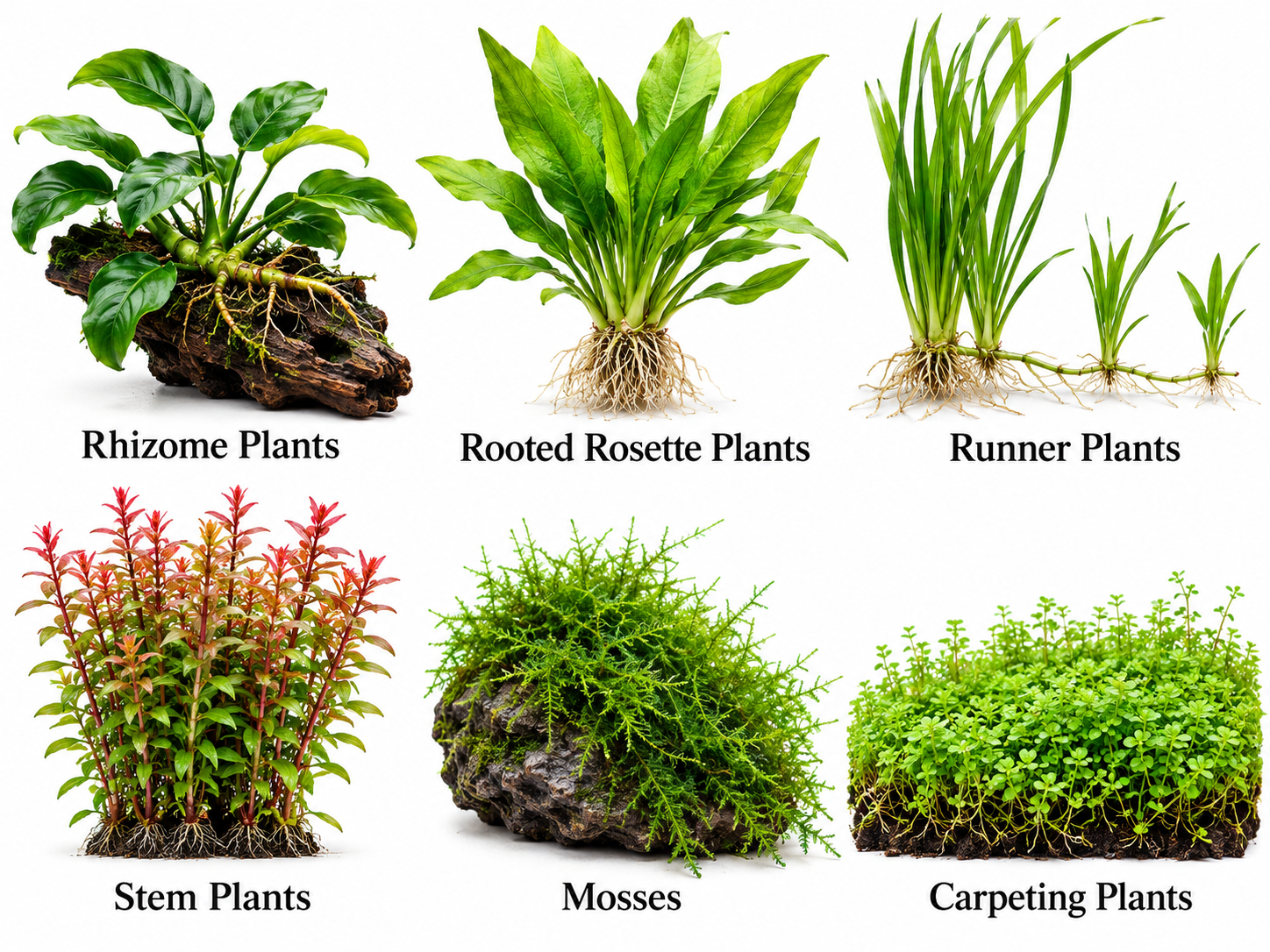
There is no single care routine that works equally well for every aquarium plant. Anubias, Java Fern, Cryptocoryne, Vallisneria, Amazon Sword, mosses and stem plants all grow differently. The most useful starting point is to identify the plant type and then match its light, planting method, nutrients and maintenance to that growth habit.
Rhizome Plants
Anubias, Java Fern and Bucephalandra grow from a thick horizontal rhizome. The rhizome should normally remain exposed. These plants are commonly attached to driftwood or rock and tend to grow more slowly than many stems.
Rooted Rosette Plants
Cryptocoryne and Amazon Sword grow from a central crown with roots extending into the substrate. They should be planted with the roots covered while keeping the crown above the substrate. Root nutrition is often useful for these plants.
Runner Plants
Vallisneria spreads by sending out runners that produce new plants. It is commonly used in the background because of its long leaves. Once established, it may need thinning so it does not spread into every part of the aquarium.
Stem Plants
Stem plants such as Rotala are planted as individual stems or small groups. They often grow faster than rhizome plants and usually need regular trimming. Cuttings can often be replanted to make the group denser.
Mosses
Mosses such as Java Moss can be attached to rocks, driftwood or mesh. They are generally easy to grow but can collect debris if allowed to become too thick. Periodic trimming helps maintain shape and water flow.
Carpeting Plants
Carpeting plants are used in the foreground and are usually divided into smaller portions during planting. Many carpets need stronger lighting, and some perform much better with added CO₂, so they should be chosen carefully for low-tech tanks.
What Care Requirements Should You Check for Any Plant?
- Light requirement.
- CO₂ requirement.
- Substrate or root nutrition needs.
- Correct planting method.
- Foreground, midground or background placement.
- Growth rate and trimming frequency.
- Mature height and spread.
Why Species-Specific Care Matters
Two plants can both be sold as “easy” but still need very different treatment. Anubias should not have its rhizome buried, while Cryptocoryne should be rooted into the substrate. Vallisneria spreads by runners, while Java Moss grows as a mat. Understanding these differences prevents many avoidable problems.
Care for Epiphyte Plants
Epiphytes such as Anubias, Java Fern and Bucephalandra are especially useful around hardscape. Their rhizomes should remain exposed, and they generally do well with moderate lighting. Because they grow slowly, avoid excessive light that encourages algae on their leaves. Remove damaged leaves and allow new growth to develop naturally from the rhizome.
Care for Root-Feeding Plants
Cryptocoryne and Amazon Sword rely more heavily on their root systems. Plant them into the substrate without burying the crown. In inert substrates, root nutrition can be particularly useful. Avoid moving established root feeders repeatedly because disturbing the root system can temporarily slow growth.
Care for Fast-Growing Stem Plants
Stem plants need more active trimming than slow-growing rhizome plants. Cut healthy tops when they reach the desired height and replant suitable cuttings if you want a denser group. Thin overcrowded stems so light reaches lower leaves and water can circulate between them.
Care for Mosses
Mosses are flexible but can trap debris when allowed to grow into very thick mats. Trim them periodically and remove loose fragments during maintenance. When attaching moss to hardscape, spread it thinly so the lower portions still receive light and water movement.
Care for New Plants During the First Month
The first few weeks are an adaptation period. Keep lighting and fertilization stable, remove leaves that clearly decay and avoid repeatedly moving plants. Some species may lose emersed nursery leaves before producing new submerged growth. Judge success by healthy new growth rather than expecting every original leaf to remain perfect.
How to Read a Species Care Guide
When you open a care guide for a particular plant, focus first on the factors that affect success in your aquarium: mature size, light requirement, CO₂ requirement, planting method and nutrient preference. Details such as propagation and trimming are useful later, but the first question should always be whether the plant actually suits your setup.
Why the Same Plant Can Look Different in Different Tanks
Plant shape, colour and growth rate can change with light intensity, nutrients, CO₂ and water conditions. A Rotala grown under strong light and CO₂ may look different from the same species in a low-tech tank. This does not automatically mean one is unhealthy. Compare the plant with the conditions in which it is being grown.
Build Your Own Plant-Care Routine
Once you understand the plant types in your aquarium, create a simple routine around them. Fast stems may need weekly trimming, slow rhizome plants may need very little attention, and rooted plants may need periodic root nutrition. A plant-specific routine is more efficient than treating every species in exactly the same way.
If you want to go deeper into this topic, read our
How to Plant Aquarium Plants Properly. You can also continue with
Aquarium Plant Maintenance Guide for the next practical step.
Frequently Asked Questions
Why do different aquarium plants need different care?
Different plant types absorb nutrients, grow and attach themselves in different ways. Their lighting, planting and trimming requirements can therefore vary considerably.
How do I care for rhizome plants?
Keep the rhizome exposed, attach the plant to hardscape where appropriate and avoid excessive light that can encourage algae on slow-growing leaves.
How can I tell whether a new aquarium plant is settling well?
Look for healthy new growth from the stem tip, crown or rhizome. Some older leaves may deteriorate during adaptation even when the plant is establishing successfully.
Final Thoughts
Caring for aquarium plants becomes much easier when each plant is treated according to its natural growth habit. Rhizome plants, rooted plants, runner plants, stem plants, mosses and carpeting plants have different planting and maintenance needs, so one generic care routine will not suit every species.
Once the basic care requirements are in place, choose plants and equipment that fit the actual setup. You can explore the
Aquarium Plants collection at Sri Maha Aquarium. Where plant nutrition is relevant, you can also review
APT Complete planted aquarium fertilizer and choose it according to your aquarium’s needs.
For help selecting suitable aquarium plants, lighting, fertilizer or a complete planted aquarium setup, contact
Sri Maha Aquarium at
+91 91086 22022.