
Home » Aquarium Setup » How to Maintain a Nano Planted Aquarium: Easy Beginner Routine
How to Maintain a Nano Planted Aquarium: Easy Beginner Routine
One of the first questions customers ask when looking at a planted aquarium is:
Will this be difficult to maintain?
The answer depends far more on the design of the aquarium than on whether it contains plants.
A densely planted, high-light, CO₂-injected aquascape can require frequent trimming and careful balancing.
A deliberately designed low-tech aquarium with slow-growing plants can be much simpler.
But “low maintenance” should never be confused with “no maintenance.”
Here is a practical routine for understanding what your aquarium actually needs.
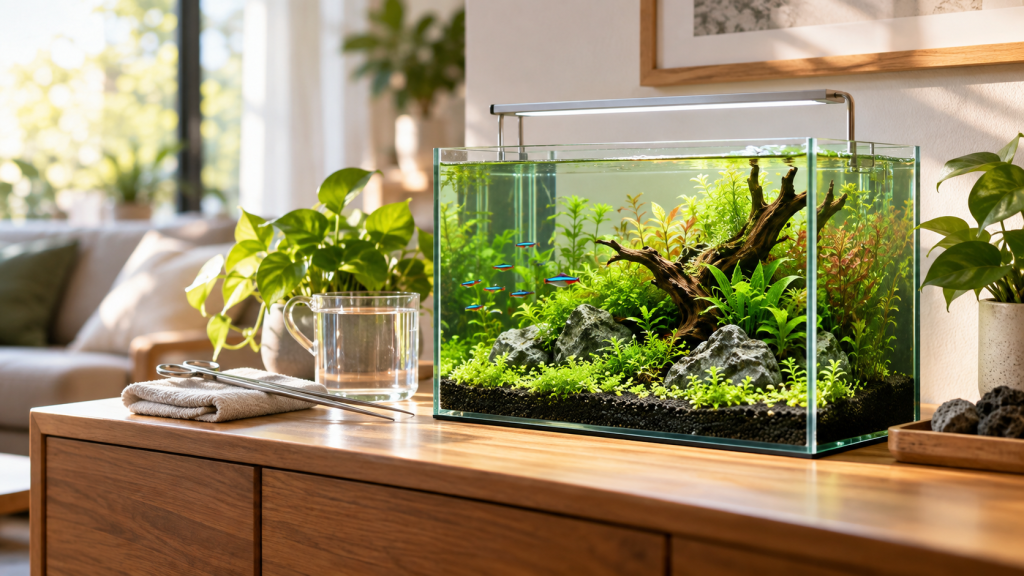
The first few weeks are different
A new aquarium is still developing biologically.
Plants are adapting, beneficial bacteria are establishing and the system has not yet reached maturity.
Tropica describes the first roughly 90 days as a critical establishment period and recommends more conservative lighting and more frequent water changes in the early weeks than in an established aquarium.
So customers should not judge a newly installed aquarium by the same routine as a six-month-old aquarium.
Lighting: use a timer
The easiest maintenance improvement is simply consistency.
For a newly planted aquarium, starting around five to six hours of light daily is a commonly recommended conservative approach. Once the plants are established and algae is controlled, a stable low-tech aquarium can generally move toward approximately seven to eight hours.
A timer is useful because it removes guesswork.
Do not switch the light on for twelve hours because you want the plants to “grow faster.”
Excess energy can create more problems than benefits.
Water changes
Fresh water helps dilute accumulated waste and reset conditions.
During the initial establishment period, planted-aquarium guides often recommend more frequent water changes, particularly when using active aquarium soil. Tropica recommends 25–50% water changes multiple times per week during the early weeks of a fresh planted setup, moving toward a regular weekly routine as the aquarium becomes established.
Your exact maintenance plan should depend on your aquarium’s livestock, feeding, water parameters and maturity.
That is why our installation consultation is useful: we can explain an appropriate starting routine for the aquarium we actually install rather than giving every customer an identical instruction sheet.
Filter maintenance
The filter should be checked regularly for reduced flow.
Do not continuously replace all biological media simply because it looks dirty.
The filter is an important habitat for beneficial bacteria.
When appropriate filter media requires cleaning, it should be handled in a way that preserves biological filtration.
The goal is to restore flow without unnecessarily destroying the bacterial community supporting the aquarium.
Glass cleaning
A light film on aquarium glass is normal over time.
A soft aquarium-safe pad or magnetic cleaner can be used where appropriate.
Cleaning small amounts regularly is much easier than waiting for a heavy buildup.
Plant maintenance
Anubias grows slowly, so pruning is normally limited.
Remove badly damaged leaves when necessary.
Moss may need occasional trimming to preserve its shape and prevent it becoming excessively dense.
Slow-growing plants are one reason this type of aquascape can remain visually controlled with relatively modest plant maintenance. Tropica’s low-tech examples using Anubias and moss report low maintenance requirements in appropriately balanced tanks.
Feeding once livestock is introduced
Overfeeding is one of the easiest ways to create avoidable aquarium problems.
Feed an appropriate amount for the livestock rather than putting food into the aquarium simply because the fish appear interested.
More uneaten food ultimately means more waste for the filtration system to process.
What about algae?
A small amount of algae does not automatically mean the aquarium has failed.
Algae becomes more likely when the balance between light, plant growth, nutrients and maintenance is disturbed.
Before buying chemical solutions, first look at:
lighting duration, feeding, water changes, plant health and filter flow.
The aquarium nitrogen cycle
Before significant livestock is introduced, the biological system needs enough beneficial bacteria and plant mass to process the waste that animals produce.
During cycling, toxic ammonia and nitrite are converted by microorganisms as the biological filtration establishes.
This is why we do not recommend treating installation day as an automatic signal to immediately fill the aquarium with livestock.
Is nano aquarium maintenance difficult?
It does not need to be.
A realistic maintenance expectation for a low-tech nano aquarium is:
a few minutes of observation during the week plus a scheduled maintenance session for water changes, glass/filter checks and occasional plant care.
What makes the aquarium easier is not neglecting it.
What makes it easier is designing it correctly from the start.
What you receive with the ₹4,999 complete setup
You receive the complete equipment and aquascaping package plus:
FREE Bangalore delivery
FREE professional installation
FREE consultation during installation
During installation, your team can explain:
how to operate the filter, recommended initial lighting routine, basic water-change procedure, plant care and what to consider before adding livestock.
Complete 10" Nature Aquarium — ₹4,999
Frequently asked questions
How often should I clean my nano aquarium?
Rather than deep-cleaning the entire aquarium, use a consistent maintenance routine involving partial water changes, glass cleaning and filter checks.
Should I replace all the aquarium water?
Routine maintenance generally uses partial water changes. Large or complete changes are used only for specific circumstances rather than as the normal established-tank routine.
How many hours should the light stay on?
A conservative starting point for a new planted aquarium is approximately five to six hours; stable low-tech tanks commonly operate around seven to eight hours depending on conditions.
Do I need to clean Aqua Soil?
Avoid aggressively stirring planted substrate. Visible debris can be gently removed during maintenance where appropriate.
Is professional maintenance compulsory?
No. This particular low-tech setup is designed so customers can learn basic routine maintenance themselves. Professional aquarium maintenance can still be useful for customers who prefer a managed service.