
Home » Aquarium filtration » How to Choose an Aquarium Filter Based on Aquarium Size
How to Choose an Aquarium Filter: Flow Rate, Filter Types & Tank Size Guide
Choosing the right aquarium filter is one of the most important decisions when setting up an aquarium. The correct filter helps maintain water quality, supports beneficial bacteria and keeps aquarium water moving through the filtration system.
With so many options available, beginners often ask: How do I choose an aquarium filter? Should you buy an internal filter, HOB filter, sponge filter or canister filter? How much flow does your aquarium need? And does a larger tank always require a more powerful filter?
This guide explains how to choose an aquarium filter based on tank size, flow rate, fish load, filtration needs, filter type and maintenance requirements.
Whether you are setting up a small freshwater aquarium or a larger planted tank, understanding these factors will help you choose the right aquarium fish tank filter for your setup.
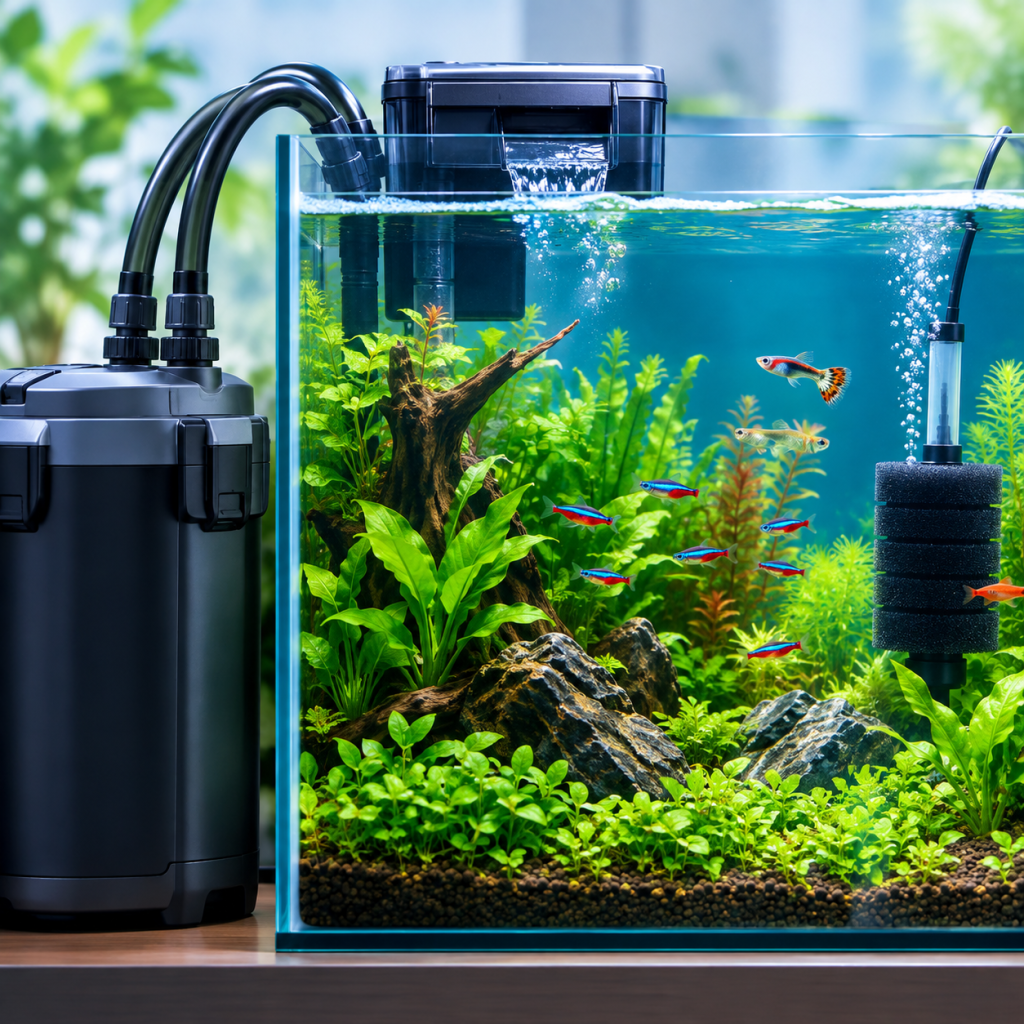
What Does an Aquarium Filter Do?
An aquarium filter does much more than simply make the water look clear. A properly selected filtration system supports several important functions in an aquarium.
Mechanical Filtration
Mechanical filtration removes physical particles such as uneaten food, fish waste, plant debris and other suspended material from the water.
Filter sponges, pads and floss are commonly used for this purpose.
Biological Filtration
Biological filtration provides surfaces where beneficial microorganisms can live. These microorganisms help process fish waste as part of the aquarium’s nitrogen cycle.
This is why filter media capacity is an important factor when choosing an aquarium filter.
Chemical Filtration
Chemical filtration uses materials such as activated carbon or specialized resins to remove or reduce certain dissolved substances from aquarium water.
Chemical filtration is not required in every aquarium and is generally used for specific purposes.
How to Choose an Aquarium Filter
When selecting a filter, do not look only at the number printed on the box. Consider the complete aquarium setup.
The main factors are:
- Aquarium size and actual water volume
- Filter flow rate
- Fish load and waste production
- Filter media capacity
- Type of aquarium filter
- Fish and plant requirements
- Maintenance requirements
- Available space and installation metho
• Start With Your Aquarium Size
The first step is to determine how much water your aquarium actually holds.
For example, a tank measuring 60 cm × 30 cm × 30 cm has a gross volume of approximately 54 litres. However, the actual water volume will be lower after accounting for substrate, rocks, wood, equipment and the space below the rim.
Tank size provides a starting point, but it should not be the only factor used to select an aquarium filter.
A filter designed for a particular aquarium volume should be checked against the manufacturer’s specifications before purchase.
• Understand Aquarium Filter Flow Rate
Filter flow rate is usually expressed in litres per hour (L/h) or gallons per hour (GPH).
Flow rate tells you how much water the filter is rated to move under its stated testing conditions.
A common way to compare filtration capacity is through turnover rate.
Aquarium Filter Turnover Formula
Turnover rate = Filter flow rate ÷ Aquarium water volume
For example, if your aquarium contains 100 litres of water and the filter is rated at 400 L/h:
400 ÷ 100 = 4 times per hour
That means the published flow corresponds to approximately four theoretical turnovers per hour.
However, this calculation should be treated as a starting point, not a universal rule. Actual flow can change because of filter media, hose length, elevation, pipework, clogging and other installation factors. Current aquarium-filter guidance also recommends looking at the manufacturer’s aquarium-capacity range and the specific meaning of its flow specification rather than relying on one universal turnover number.
• Do Not Choose a Filter Based on Flow Alone
A filter with a higher flow number is not automatically the right filter for your aquarium.
Two filters can have similar published flow rates but differ significantly in:
- Filter media capacity
- Physical size
- Mechanical filtration area
- Biological media capacity
- Energy consumption
- Adjustability
- Maintenance requirements
- Installation design
For example, a canister filter can provide substantial space for filter media while a compact internal filter may occupy much less space but have a smaller media volume.
When comparing an aquarium fish tank filter, look at both flow and filtration capacity.
• Consider Your Fish Load
The number and type of fish in your aquarium affect filtration requirements.
A lightly stocked aquarium may have a relatively low waste load, while a heavily stocked aquarium produces more waste and can place greater demands on mechanical and biological filtration.
Fish species also matter.
Some fish prefer gentler water movement, while others are comfortable with stronger circulation.
Therefore, the right aquarium filter is not simply the biggest filter you can install. It should provide sufficient filtration while producing a flow pattern that suits the livestock.
• Choose the Right Filter Type
There are several common aquarium filter types.
Internal Filters
Internal filters are installed inside the aquarium.
They are commonly used in smaller and medium-sized setups because they are relatively compact and straightforward to install.
For smaller aquariums, a compact internal filter such as the EHEIM Pickup internal filter can be considered based on the tank size and filtration requirements.
Advantages:
- Compact
- Simple installation
- Suitable for many smaller aquariums
- Easy access for basic maintenance
Considerations:
- Occupies space inside the aquarium
- Usually has less media capacity than a large external canister
- Water circulation can be more localized
Hang-On-Back (HOB) Filters
HOB filters are mounted on the back or side of the aquarium and return filtered water into the tank.
They can be practical for beginners and are easy to access for maintenance.
If you prefer a hang-on-back setup, you can explore options such as the SunSun Hang-On Aquarium Filter and compare the model with your aquarium requirements
Advantages:
- Easy installation
- Convenient maintenance
- Good visibility into the filter area
- Suitable for many small and medium aquariums
Considerations:
- Requires suitable space behind the aquarium
- Flow may need adjustment for fish that prefer calmer water
Sponge Filters
Sponge filters use an air pump to move water through a sponge.
They are commonly used in breeding tanks, shrimp tanks and other setups where gentle filtration is useful.
Advantages:
- Simple design
- Gentle water movement
- Useful biological filtration surface
- Easy to clean
Considerations:
- Requires an air pump
- Less mechanical polishing than some other filter types
- Usually less suitable where a compact high-capacity filtration system is required
Canister Filters
Canister filters are external filters that sit outside the aquarium and circulate water through a larger body of filter media.
They are commonly selected for larger aquariums, planted aquariums and setups where greater media capacity is useful. For example, the EHEIM Classic canister filter is an external filtration option that can be considered based on your aquarium size and filtration requirements.
Advantages:
- Large media capacity
- Strong biological filtration potential
- Flexible media configuration
- Keeps most equipment outside the display tank
Considerations:
- Usually costs more than basic internal or HOB filters
- Installation is more involved
- Maintenance requires removing and servicing the external canister
EHEIM’s current external-filter range includes several canister-filter families such as classic, eXperience, ecco pro, professionel 3, professionel 4+, professionel 5e and classicVARIO+e.
• Can an Aquarium Filter Be Too Strong?
Yes.
A filter can provide enough filtration while producing more water movement than certain fish or plants need.
Signs of excessive flow can include:
- Fish constantly struggling against the current
- Fish hiding behind decorations
- Plants being pushed continuously in one direction
- Uneaten food moving excessively around the aquarium
If a filter provides more flow than necessary, options such as a spray bar, flow adjustment or better outlet positioning can help distribute the water more gently.
The goal is not simply maximum flow. The goal is effective filtration with suitable circulation.
• Filter Media Capacity Matters
When choosing an aquarium filter, consider not only the flow rate but also how much filter media the system can hold. The amount and type of filter media play an important role in mechanical, biological and chemical filtration.
The amount and type of filter media also matter when selecting an aquarium filter. For example, biological media such as Seachem Matrix can be used in suitable filtration systems.
A typical filtration system may include:
Mechanical media → Biological media → Optional chemical media
Mechanical media can capture larger particles before water reaches finer filtration stages.
Biological media provides surfaces for beneficial microorganisms.
Chemical media can be used when a specific water-treatment purpose exists.
The right balance depends on the aquarium and the filter design.
• Consider Maintenance Before Buying
A filter that is difficult to maintain may eventually be neglected.
Before choosing an aquarium filter, consider:
- How easy is it to open?
- How easy is it to remove the media?
- Can the flow components be cleaned easily?
- Are replacement pads or media available?
- How easy is it to clean the impeller and hoses?
- How frequently will the filter require servicing?
For example, EHEIM’s professionel 4+ range includes features such as a removable prefilter and individual filter baskets designed to make cleaning and media handling easier.
• Choosing a Filter for a Planted Aquarium
Planted aquariums require filtration that provides good water circulation without creating excessive turbulence.
When selecting a filter for a planted aquarium, consider:
- Aquarium size
- Plant density
- Fish load
- Desired circulation
- Filter media capacity
- Outlet design
- CO₂ usage, if applicable
A canister filter can be particularly useful where you want substantial media capacity while keeping equipment outside the display aquarium.
The outlet can also be positioned to distribute water through areas that might otherwise have poor circulation.
• How to Choose an Aquarium Filter Based on Aquarium Size
Aquarium size is useful as a starting point, but it should always be combined with livestock and manufacturer specifications.
Small Aquariums
Small tanks may work well with compact internal, sponge or HOB filtration depending on livestock and setup.
Medium Aquariums
Medium-sized aquariums provide more flexibility. Internal, HOB and canister filters may all be appropriate depending on the aquarium design.
Large Aquariums
Large aquariums often benefit from external filtration because canister systems can provide greater space for filtration media and keep much of the equipment outside the display tank.
EHEIM’s current product range demonstrates this range of applications, with models designed for different aquarium capacities. For example, the EHEIM classic series currently lists models covering aquariums from approximately 50 litres through 1,500 litres, depending on the model.
• Should You Choose a Canister Filter?
A canister filter may be worth considering when you want:
- Higher filter-media capacity
- Strong biological filtration potential
- Flexible media configuration
- External installation
- Efficient circulation for a larger aquarium
However, a canister filter is not automatically necessary for every aquarium.
A smaller aquarium with a modest fish load may be adequately served by another filter type.
The best choice depends on the complete setup rather than the filter’s perceived size or price
• What Makes a Good Aquarium Fish Tank Filter?
A good aquarium fish tank filter should match your aquarium rather than simply having the highest advertised flow rate.
Look for a filter that provides:
Suitable flow + sufficient media capacity + appropriate filtration type + manageable maintenance
This combination is more useful than choosing a filter based on one specification.
• Common Mistakes When Choosing an Aquarium Filter
Choosing Only by Tank Size
Two aquariums with the same water volume can have very different stocking levels and filtration requirements.
Choosing Only by Flow Rate
A high flow number does not tell you everything about the filter’s media capacity or filtration design.
Ignoring the Manufacturer’s Specifications
Always check the exact model’s recommended aquarium capacity and published specifications.
Choosing Excessive Flow for Sensitive Livestock
More circulation is not always better for every species.
Ignoring Maintenance
A filter should be practical to clean and service regularly.
Buying an Undersized Filter
An undersized filtration system may have limited media capacity and insufficient circulation for the actual aquarium setup.
• Where Does EHEIM Fit Into Your Aquarium Filter Choice?
Once you understand tank size, flow rate, filter types and media capacity, it becomes easier to evaluate specific brands and models.
EHEIM offers multiple external-filter families, including the classic, eXperience and professionel series, with different designs and features for different aquarium requirements.
For beginners, the important step is not to choose an EHEIM model simply because it is a well-known brand. Instead, first determine what your aquarium needs, then compare the EHEIM model specifications against those requirements.
Our upcoming EHEIM guides can help you compare individual models and understand which options are suitable for different aquarium sizes and setups.
Frequently Asked Questions
What is the best aquarium filter for beginners?
There is no single best filter for every beginner. The right option depends on aquarium size, livestock, desired flow, media capacity, installation space and maintenance preferences.
How do I choose an aquarium filter for my tank?
Start with your aquarium’s actual water volume and the manufacturer’s recommended tank range. Then compare flow rate, media capacity, livestock requirements, filter type and maintenance needs.
uarium filter turnover rate?
Turnover rate is the theoretical number of times the filter’s published flow could move the aquarium’s water volume in one hour.
Is a higher aquarium filter flow rate better?
Not necessarily. Higher flow can provide strong circulation, but excessive current may be unsuitable for some fish and aquarium plants. Filter capacity and water distribution are also important.
What type of filter is best for a planted aquarium?
Internal, HOB and canister filters can all be used in planted aquariums. Canister filters are often considered when higher media capacity and flexible water circulation are useful.
Final Thoughts
Choosing an aquarium filter becomes easier when you consider your tank size, fish load, required flow rate, filter type, filter media capacity and maintenance needs together. After understanding these factors, you can decide whether an internal filter, HOB filter, sponge filter or canister filter is more suitable for your aquarium. If your aquarium requires greater filter-media capacity, flexible filtration and external installation, a canister filter may be a suitable option to consider.
Once you have decided on the type of filter that fits your aquarium, you can compare the specifications of suitable models and choose one based on your actual tank requirements. If you decide to go with an EHEIM canister filter or another aquarium filtration solution, Sri Maha Aquarium can help you select a suitable option for your setup.
For assistance with choosing an aquarium filter, contact Sri Maha Aquarium at +91 9108622022 or visit Sri Maha Aquarium.