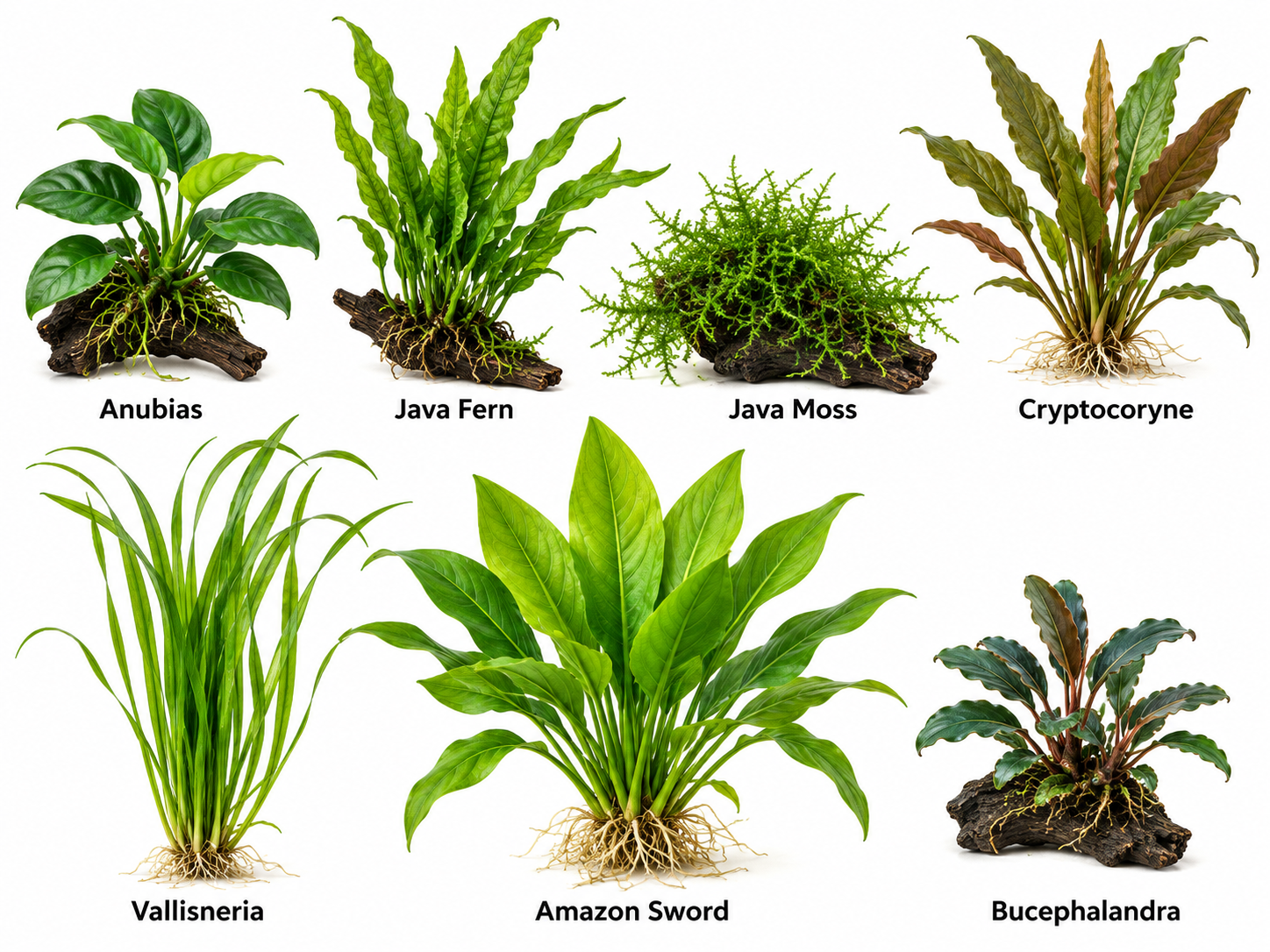
The easiest aquarium plants for beginners are not necessarily the most colourful or unusual. The best beginner plants are the ones that tolerate normal aquarium conditions, do not require constant trimming and can grow without a complicated CO₂ system.
What Makes a Plant Beginner-Friendly?
A good beginner plant usually has moderate or low light requirements, tolerates small changes in water conditions and does not need precise CO₂ control. It should also have a simple planting method and a manageable growth rate.
Anubias
Anubias is one of the easiest plants to keep. It grows slowly, works under low to medium light and can be attached to driftwood or rock. The thick rhizome should remain exposed rather than being buried in the substrate.
Java Fern
Java Fern is another dependable choice for beginners. It also grows from a rhizome and can be attached to hardscape. It does not need a nutrient-rich substrate because it is not normally planted with its rhizome buried.
Java Moss
Java Moss is useful for shrimp tanks, breeding tanks and natural-style aquascapes. It can be attached to rocks, wood or mesh. It is easy to grow but should be trimmed occasionally so it does not become too dense.
Cryptocoryne
Many Cryptocoryne varieties are excellent beginner plants once established. They are rooted plants and usually prefer stable conditions. Some may lose older leaves after being moved or replanted, but healthy roots often produce new submerged leaves.
Vallisneria
Vallisneria is a useful background plant with long strap-like leaves. It spreads by runners and can create a dense planted background. It is especially useful when you want height without complicated care.
Amazon Sword
Amazon Sword is a classic rooted plant for medium and larger aquariums. It can become large, so tank size should be considered before planting. Good root nutrition is helpful because it is a strong root feeder.
Bucephalandra
Bucephalandra is slower growing and decorative. It is typically attached to rock or wood with the rhizome exposed. It suits aquarists who want compact plants around hardscape and do not mind slower growth.
Which Ones Should You Start With?
For a simple low-tech aquarium, a combination of Anubias, Java Fern, Java Moss and Cryptocoryne is a safe starting point. Add Vallisneria if you need a taller background. Add Amazon Sword if the tank is large enough and you can provide root nutrition.
Best Beginner Plants for Low Light
If your aquarium uses a basic LED and does not have very intense lighting, Anubias, Java Fern and many Cryptocoryne varieties are strong choices. These plants do not need to be pushed with high light to look good. Keeping the light moderate can also make the aquarium easier to balance, especially when there is no pressurised CO₂ system.
Best Beginner Plants Without CO₂
For a non-CO₂ tank, choose plants that are naturally comfortable with slower growth. Anubias, Java Fern, Java Moss, Vallisneria and several Cryptocoryne varieties are commonly used for this reason. They still need suitable light and nutrients, but they do not force the beginner to install and tune a pressurised CO₂ system immediately.
Best Choices by Placement
For the foreground, keep some open space or use compact low-growing species that match your light. In the midground, Cryptocoryne, smaller Anubias and Bucephalandra work well around hardscape. Vallisneria and taller rooted or stem plants suit the background. Choosing by placement makes the final layout more balanced and helps prevent taller plants from shading everything else.
What Beginners Should Avoid at First
There is nothing wrong with advanced plants, but very demanding carpeting plants, delicate red stems and species that need high light plus stable injected CO₂ can create unnecessary frustration in a first planted aquarium. Learn how your lighting, fertilization and maintenance routine affect easy plants first. Once you can keep those healthy consistently, you will have a much better foundation for advanced species.
How to Tell Whether an Easy Plant Is Doing Well
Do not judge success only by speed. Slow-growing plants can be perfectly healthy even when they add only a few new leaves. Look for firm new growth, good colour for the species and roots or rhizomes that remain healthy. If new growth is steadily appearing and old leaves are not rapidly deteriorating, the plant is usually settling well.
How Many Beginner Species Should You Mix?
For a first planted tank, three to five compatible plant types are often easier to manage than a collection of many unrelated species. Repeating the same plant in several areas also makes the aquascape look more intentional. A smaller plant list makes it easier to learn how each species grows, how often it needs trimming and whether the lighting or nutrient routine needs adjustment.
Give Easy Plants the Right Conditions
“Easy” does not mean indestructible. Even beginner plants can struggle if they are planted incorrectly, kept in complete darkness or repeatedly moved. Anubias and Java Fern should keep their rhizomes exposed, rooted plants need secure planting, and all plants benefit from stable conditions. Easy species reduce the difficulty of the setup, but basic care still matters.
If you want to go deeper into this topic, read our
How to Choose Aquarium Plants for Your Tank. You can also continue with
Aquarium Plant Maintenance Guide for the next practical step.
Frequently Asked Questions
What is the easiest aquarium plant to keep?
Anubias and Java Fern are among the easiest choices for many beginners because they tolerate moderate lighting and do not need to be rooted deeply in the substrate.
Which beginner plants can grow without CO₂?
Anubias, Java Fern, Java Moss, Vallisneria and many Cryptocoryne varieties can usually be grown in suitable low-tech tanks without pressurised CO₂.
Are beginner plants completely maintenance-free?
No. Easy plants still need appropriate light, nutrients, correct planting and occasional trimming or removal of damaged leaves.
Final Thoughts
Beginner aquarium plants are easiest to keep when the setup is kept simple and the species are matched to the tank’s light and maintenance level. Starting with a few forgiving plants makes it easier to learn how the aquarium responds before moving to more demanding species.
Once the basic care requirements are in place, choose plants and equipment that fit the actual setup. You can explore the
Aquarium Plants collection at Sri Maha Aquarium. Where plant nutrition is relevant, you can also review
APT Complete planted aquarium fertilizer and choose it according to your aquarium’s needs.
For help selecting suitable aquarium plants, lighting, fertilizer or a complete planted aquarium setup, contact
Sri Maha Aquarium at
+91 91086 22022.